What distinguishes oral history from auto-autobiography?
A rubric comparing oral history practice with Automated Biographical Elicitation and Re-tell (ABER)
What makes an account of the past history?
Millions of consumers are now reading their family past in forms that were collected through conversational AI and told back to them in a machine's words. The vendors call this history. The consumers call it history. But what makes it so?
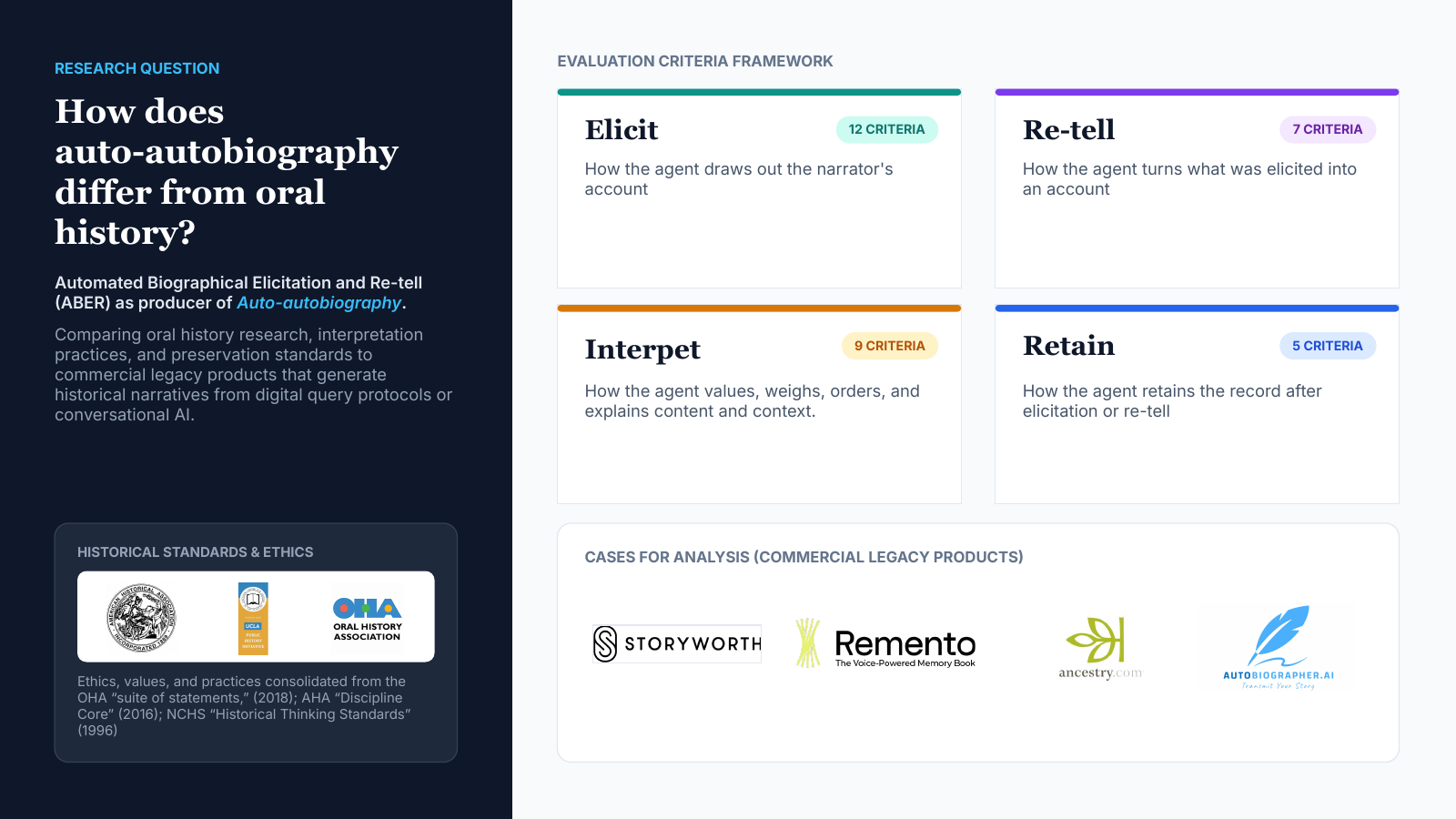
This project studies AI-enabled legacy tools that help families research, describe, and share accounts of their past. It compares them with the goals, conventions, ethics, and practices of oral historians.
What is Automated Biographical Elicitation and Re-tell (ABER)?
Living memoir platforms such as StoryWorth, Remento, and Autobiographer use algorithmic question protocols or conversational AI to elicit an older adult's reminiscences, reformulate them, and return them as an audience-sensitive narrative in book form. Ancestry's newest products move similarly, summarizing documents and adding context to a subscriber's collection. I call this two-stage process Automated Biographical Elicitation and Re-tell (ABER). I call its product auto-autobiography, a life narrative grounded in the documented reminiscences of a human author but retold without clear methodological transparency.
ABER reduces the friction and cost of later-life review, a practice shown to ease depression and loneliness in older adults (Pinquart and Forstmeier 2012; Yang et al. 2025). The family stories such reviews preserve are associated with stronger identity and well-being in younger generations (Duke et al. 2008; Merrill and Fivush 2016). I raise the question of whether ABER extends these social benefits. But my primary focus is definitional. I propose a rubric that consolidates the disciplinary practices of oral history in a form that facilitates comparison with auto-autobiography.
A rubric for comparing oral history and ABER
Comparison requires a stated consensus identifying what oral history requires of practitioners. The field has resisted one for decades, moving away from "standards" toward a "suite of statements" on principles, ethics, and practice (Gluck 2018; Reeves and Milligan 2018). I draw on what three efforts hold in common. They are the National Standards for History (National Center for History in the Schools 1996), the History Discipline Core (American Historical Association 2016), and the Principles and Best Practices of the Oral History Association (Oral History Association 2018). Each served a different purpose and none anticipated comparison with large language models.
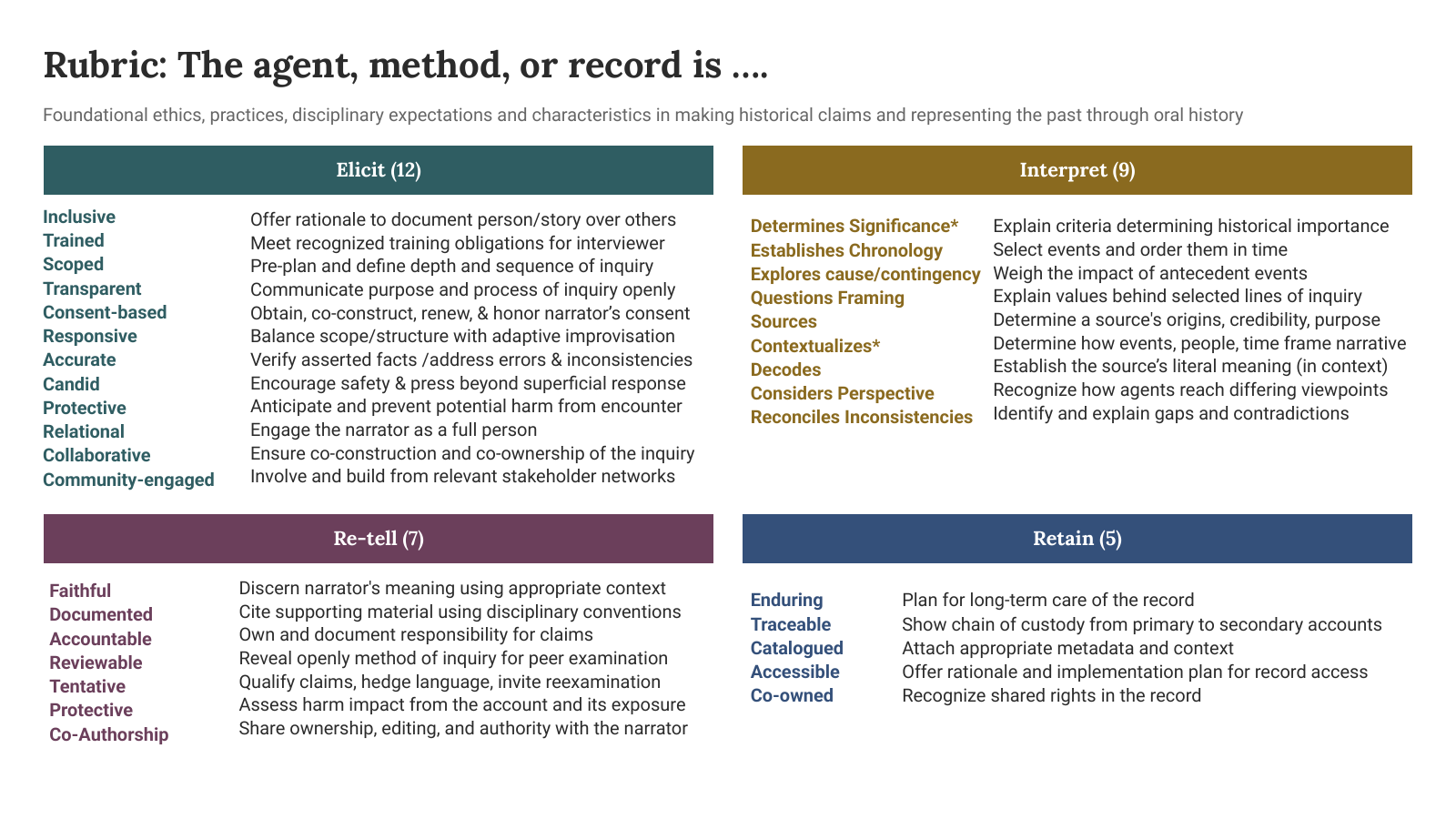
The proposed and preliminary rubric addresses criteria from four categories.
- Elicit 12 criteria How the inquiry is prepared and conducted
- Re-tell 7 criteria How the inquiry results are described
- Interpret 9 criteria What historical thinking practices are applied in elicitation and re-tell
- Retain 5 criteria How the record is kept, described, accessed, and owned
The three source efforts are AHA (2016), OHA (2018), and NCHS (1996).
What does candor mean in oral history?
The early work has gravitated toward candor. The OHA's "Oral History Best Practices" asks interviewers to provide "challenging and perceptive inquiry," "not being satisfied with superficial responses," and to strive with narrators "to record candid information of lasting value to future audiences" (Oral History Association 2018b).
The passage identifies the problem of superficiality and positions candor as a proper aim of historical inquiry. Candor goes beyond any authentication step or corroboration of facts. It is a disposition, evidenced by openness, sincerity, forthrightness, and a willingness to tell it the way it is. In this sense, the practitioner's commitment to emotional safety, care, and validation is not merely an ethical stance; it is a method that produces better history.
Does ABER elicit candor? Researchers in other fields have found that non-human interviewers provide safety and anonymity that increase disclosure (Lucas et al. 2014; Lucas et al. 2017). Other research complicates the picture. Participants in one experiment reported disclosing no more intimately to a chatbot than to a person (Croes et al. 2024). Across eleven leading models, AI affirmed users far more often than humans did, and users preferred it (Cheng et al. 2026). A generative chatbot interviewer induced more than three times as many immediate false memories as a control condition (Chan et al. 2024). None of these studies concerns life review.
Read the Critical Reflection, "Can Oral History and Auto-autobiography Have a Candid Conversation?"
Read further
- Mucher, Stephen (2026). Can Oral History and Auto-autobiography Have a Candid Conversation? (PDF)
- Abstract: Codified Historical Method and Automated Life-Story Tools (PDF)
- Slides: Research question and rubric overview (PDF)
- Rubric: Automated Biographical Elicitation and Re-tell (ABER) and Oral History Comparison
Feedback request
- From historians and oral historians. Which criteria are wrong, missing, or miscredited? Critique a criterion
- From professionals who design elicitation systems. How would your agent address one of these prompts? Respond to a prompt
- From any consumer familiar with ABER products through a parent or grandparent. What did it ask, and what did it miss? Share an account
The links open a public form on GitHub and require a free account. Email works as well, at stephen@sondagestandard.com.
About
Stephen Mucher is a social historian who studies geragogy, the way adults in later life learn and make meaning. He is a 2026 Visiting Fellow at the Digital Life Initiative at Cornell Tech. He holds a Ph.D. from the University of Michigan and previously directed the Osher Lifelong Learning Institute at UCLA, after academic posts at Bard College and UC Berkeley. His commentary has appeared in the Washington Post, the Los Angeles Times, and on NPR.
He is the founder of Sondage, a governance platform for the documentation of human life in the synthetic age. Sondage certifies independent practitioners to conduct sustained documentary inquiry with adults in the later decades of life.
stephen@sondagestandard.com · ORCID 0009-0000-8310-0469 · LinkedIn · Digital Life Initiative
The automated life-story products
Commercial products and one research prototype referred to in this project.
- Storyworth · Sends a storyteller one question a week for a year. Answers are written or recorded by phone, then compiled into a hardcover book.
- Remento · Sends weekly prompts that the storyteller answers by speaking. Software rewrites each recording as a written story and compiles the stories into a book, with QR codes linking back to the recordings.
- Autobiographer · An app in which a conversational AI interviews the user by voice and turns the conversations into written stories and a longer life story.
- StoryFile · Records video interviews, then uses AI to play back the relevant recorded answer when a viewer asks a question.
- Ancestry · AI Stories turns historical records attached to a family tree into narrated stories with added historical context. Ask AncestryAI generates stories from documents a subscriber uploads.
- StorySage · A research prototype (Talaei et al. 2025) that uses several coordinated AI agents to conduct conversational autobiography writing.
History standards proxy
- OHA Core Principles
- OHA Statement on Ethics
- Oral History Best Practices
- Archiving Oral History (2019)
- Guidelines for Social Justice Oral History Work (2022)
- Oral History: Defined
- NCHS Historical Thinking Standards (1996)
- AHA History Discipline Core (2016)
Bibliography
American Historical Association. 2016. "AHA History Tuning Project: 2016 History Discipline Core." December 2016. https://www.historians.org/resource/history-discipline-core/
American Historical Association. 2025. "Guiding Principles for Artificial Intelligence in History Education." Approved by AHA Council, July 29, 2025. https://www.historians.org/resource/guiding-principles-for-artificial-intelligence-in-history-education/
American Historical Association. n.d. "Ad Hoc Committee on Artificial Intelligence in History Research and Publications." Accessed September 19, 2026. https://www.historians.org/group/ad-hoc-committee-on-artificial-intelligence-in-history-research-and-publications/
Ancestry. n.d. "Welcome to Ancestry." Ancestry Corporate. Accessed September 19, 2026. https://www.ancestry.com/corporate
Chan, Samantha, Pat Pataranutaporn, Aditya Suri, Wazeer Zulfikar, Pattie Maes, and Elizabeth F. Loftus. 2024. "Conversational AI Powered by Large Language Models Amplifies False Memories in Witness Interviews." Preprint, arXiv, August 8. https://doi.org/10.48550/arXiv.2408.04681
Cheng, Myra, Cinoo Lee, Pranav Khadpe, Sunny Yu, Dyllan Han, and Dan Jurafsky. 2026. "Sycophantic AI Decreases Prosocial Intentions and Promotes Dependence." Science 391:eaec8352. https://doi.org/10.1126/science.aec8352
COPE (Committee on Publication Ethics). 2023. "Authorship and AI Tools." COPE position statement, February 13, 2023. https://publicationethics.org/guidance/cope-position/authorship-and-ai-tools
Croes, Emmelyn A. J., Marjolijn L. Antheunis, Chris van der Lee, and Jan M. S. de Wit. 2024. "Digital Confessions: The Willingness to Disclose Intimate Information to a Chatbot and Its Impact on Emotional Well-Being." Interacting with Computers 36 (5): 279–92. https://doi.org/10.1093/iwc/iwae016
Duke, Marshall P., Amber Lazarus, and Robyn Fivush. 2008. "Knowledge of Family History as a Clinically Useful Index of Psychological Well-Being and Prognosis: A Brief Report." Psychotherapy: Theory, Research, Practice, Training 45 (2): 268–72. https://doi.org/10.1037/0033-3204.45.2.268
Gluck, Sherna Berger. 2018. "The History behind Our Work, 1966–2009." In OHA Principles and Best Practices. Oral History Association. https://oralhistory.org/principles-and-best-practices-revised-2018/
Heinz, Michael V., Daniel M. Mackin, Brianna M. Trudeau, et al. 2025. "Randomized Trial of a Generative AI Chatbot for Mental Health Treatment." NEJM AI 2 (4). https://doi.org/10.1056/AIoa2400802
Larson, Mary. 2026. "Oral History Encounters AI: An Exploration of Core Principles and Best Practices, Context and Consent." Oral History Review 53 (1): 93–110. https://doi.org/10.1080/00940798.2026.2625663
Lucas, Gale M., Jonathan Gratch, Aisha King, and Louis-Philippe Morency. 2014. "It's Only a Computer: Virtual Humans Increase Willingness to Disclose." Computers in Human Behavior 37:94–100. https://doi.org/10.1016/j.chb.2014.04.043
Lucas, Gale M., Albert Rizzo, Jonathan Gratch, et al. 2017. "Reporting Mental Health Symptoms: Breaking Down Barriers to Care with Virtual Human Interviewers." Frontiers in Robotics and AI 4:51. https://doi.org/10.3389/frobt.2017.00051
Merrill, Natalie, and Robyn Fivush. 2016. "Intergenerational Narratives and Identity across Development." Developmental Review 40:72–92. https://doi.org/10.1016/j.dr.2016.03.001
National Center for History in the Schools. 1996. National Standards for History. Basic ed. Los Angeles: National Center for History in the Schools, University of California, Los Angeles. https://phi.history.ucla.edu/nchs/history-standards
Oral History Association. 2018. OHA Principles and Best Practices. Adopted October 2018. https://oralhistory.org/principles-and-best-practices-revised-2018/
Oral History Association. 2018a. "OHA Statement on Ethics." In OHA Principles and Best Practices. Adopted October 2018. https://oralhistory.org/oha-statement-on-ethics/
Oral History Association. 2018b. "Oral History Best Practices." In OHA Principles and Best Practices. Adopted October 2018. https://oralhistory.org/best-practices/
Oral History Association. n.d. "Oral History: Defined." Accessed September 18, 2026. https://oralhistory.org/about/do-oral-history/
Pinquart, Martin, and Simon Forstmeier. 2012. "Effects of Reminiscence Interventions on Psychosocial Outcomes: A Meta-Analysis." Aging & Mental Health 16 (5): 541–58. https://doi.org/10.1080/13607863.2011.651434
Reeves, Troy, and Sarah Milligan. 2018. "2018 Principles and Best Practices Overview." In OHA Principles and Best Practices. Oral History Association. https://oralhistory.org/principles-and-best-practices-revised-2018/
Sheftel, Anna, and Stacey Zembrzycki. 2026. "Oral History Is Not Just Data: Amplifying Humanistic Practices in the Age of Artificial Intelligence." Main essay in "A Roundtable on Oral History and Artificial Intelligence: Making a Case for Humans." Oral History Review 53 (1). https://doi.org/10.1080/00940798.2026.2618280
Talaei, Shayan, Meijin Li, Kanu Grover, James Kent Hippler, Diyi Yang, and Amin Saberi. 2025. "StorySage: Conversational Autobiography Writing Powered by a Multi-Agent Framework." In Proceedings of the 38th Annual ACM Symposium on User Interface Software and Technology (UIST '25). New York: ACM. https://doi.org/10.1145/3746059.3747681
Thiagarajan, Sriram. 2026. "Sriram Thiagarajan of Ancestry: How We Leveraged AI to Take Our Company to the Next Level." Interview by Chad Silverstein. Authority Magazine, June 12, 2026. https://medium.com/authority-magazine/sriram-thiagarajan-of-ancestry-how-we-leveraged-ai-to-take-our-company-to-the-next-level-356e851ac132
Thompson, Paul, and Joanna Bornat. 2017. The Voice of the Past: Oral History. 4th ed. Oxford University Press.
Wang, Echo. 2025. "Exclusive: Blackstone Weighs Options for Ancestry.com, Including Sale or IPO, Sources Say." Reuters, September 25, 2025. https://www.reuters.com/business/exclusive-blackstone-mulls-options-ancestrycom-including-possible-sale-or-ipo-2025-09-25/
Wasik, Bill. 2025. "A.I. Is Poised to Rewrite History. Literally." New York Times Magazine, June 16, 2025. https://www.nytimes.com/2025/06/16/magazine/ai-history-historians-scholarship.html
Yang, Haiqi, Qiqing Zhong, Bingyue Han, et al. 2025. "Effects of Reminiscence Therapy for Loneliness in Older Adults: A Systematic Review and Meta-Analysis." Age and Ageing 54 (5): afaf136. https://doi.org/10.1093/ageing/afaf136
Cite and reuse
To cite the rubric: Mucher, Stephen. 2026. "ABER and Oral History: Comparison Rubric." Preliminary version 0.1, October 2026. Digital Life Initiative, Cornell Tech. https://auto-autobiography.stephenmucher.org/rubric.html
To cite the commentary: Mucher, Stephen. 2026. "Can Oral History and Auto-autobiography Have a Candid Conversation?" Digital Life Initiative, Cornell Tech. https://auto-autobiography.stephenmucher.org/essay.html
The rubric and the texts on this site are licensed under Creative Commons Attribution 4.0 International. Use them, adapt them, and share them. Credit Stephen Mucher. The files and their version history are in the repository.